EN
EN UA
UA



 Login
Login 

Cloud-Based POS System vs. On-Premises: Why Businesses Are Flocking to the Cloud



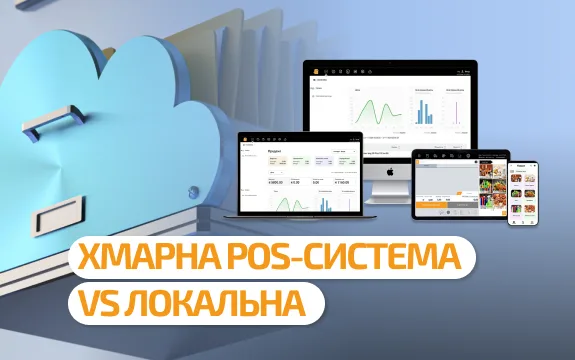
The retail and HoReCa sectors are undergoing a systemic transformation: companies are rethinking what a POS system should be and how to manage their businesses in real time. Whereas the standard used to be a combination of “local software + on-site hardware,” today more and more businesses are switching to cloud POS systems, which provide full remote control, scalability, and effective network management.
What looked like a technological innovation as recently as 2018–2020 had become the new operational standard by the end of the 2020s. The key selling point for businesses has become the ability to manage a point of sale—or an entire network—without needing to be in a specific physical location.
Global market data: Cloud solutions are growing exponentially
Analytics from international research firms confirm the shift toward cloud POS.
The IMARC Group estimates the global cloud POS market at USD 5.11 billion in 2024, projecting growth to USD 25.21 billion by 2033. For the segment, this translates to a compound annual growth rate (CAGR) of approximately 18.4%.
At the same time, Straits Research projects an even more ambitious trajectory: from USD 7.73 billion in 2025 to USD 45.2 billion in 2033, with a significantly higher CAGR—approximately 24.7%.
The overall market for POS solutions (on-premises + cloud) is also growing:
According to estimates by Fortune Business Insights, the market was valued at approximately USD 33–34 billion in 2024, and is expected to exceed USD 110 billion by 2032–2033.These figures demonstrate not merely steady growth, but a fundamental rethinking of the entire operational management framework in retail and foodservice. On-premises systems are no longer able to meet the new demands for speed, reliability, and scalability.
Why Cloud-Based POS Systems Are Replacing On-Premises Ones: Key Drivers of the Transition
The shift to cloud POS is driven by a number of factors that impact a business’s bottom line and operational efficiency.
The first and most obvious factor is scalability. Cloud solutions make it possible to open new locations without complex IT procedures: there’s no need to install servers, configure local databases, or purchase specialized computers. All you need to do is connect the new workstation to the cloud system, after which the manager immediately gains access to sales data, inventory levels, and analytics.
The second factor is reduced infrastructure costs. On-premises POS systems require hardware, dedicated software, regular updates, technical support, and often even in-house IT staff. Cloud POS completely eliminates these costs: the server infrastructure is hosted by the provider, and updates are performed automatically.
Another important aspect is real-time data access. Sales figures, inventory levels, staff activity, revenue, and other key metrics are available from any device. This allows managers to make decisions quickly—especially in the dynamic retail and HoReCa environments.
Additionally, cloud-based systems offer a significant security advantage. They are updated centrally, feature built-in data encryption, and all critical processes are replicated across data centers. On-premises POS solutions often fall short in this regard—delayed updates or hardware failures can lead to downtime or even data loss.
Integration is another key advantage. Modern businesses work with acquiring, delivery services, CRM, inventory management, loyalty programs, and analytics services. Cloud POS easily integrates with this entire ecosystem, forming a unified digital management framework.
Why even large networks are moving to the cloud
For large chain businesses, the issue of efficiency becomes even more pressing. Deploying a local POS infrastructure across dozens or hundreds of locations means:
- maintaining equipment at each location;
- managing separate databases;
- updating software manually;
- monitoring the stability of all components locally.In the cloud model, all these procedures become unnecessary. Network management is centralized.
Management gains the ability to view all locations on a single dashboard:
sales, inventory, product mix metrics, staff performance—everything is updated online. A new location can be connected in minutes, and its data is immediately reflected in the overall system.This centralization reduces operating costs, accelerates the rollout of new locations, and ensures uniform accounting standards across the entire network.
What Risks Exist and Why They Are No Longer Critical
Despite the rapid growth of cloud POS, businesses often raise questions about the risks involved. The most common concerns relate to internet dependency, security, and the stability of cloud servers.
However, most modern cloud solutions already offer technologies that eliminate these risks:
- offline mode, which allows you to work even without an internet connection and synchronize data with the server once connectivity is restored;
- data encryption that meets banking standards;
- backup capabilities, ensuring that information is not lost even in the event of technical failures;
- fault-tolerant data centers with geographic redundancy.
As a result, cloud POS systems are no less reliable than on-premises systems, and are often even more secure and stable.
Conclusion
The global POS technology market is undergoing fundamental changes. Analytics show a sharp rise in the cloud POS segment, and the practical benefits of these systems are confirmed by the experience of businesses of all sizes—from small cafes and shops to large chain operators. Cloud systems allow businesses to scale without investing in complex hardware, manage operations from anywhere, reduce IT infrastructure costs, and access real-time analytics. It is precisely these factors that make cloud POS the natural next step for companies seeking to modernize their processes and operate in a dynamic digital environment.